


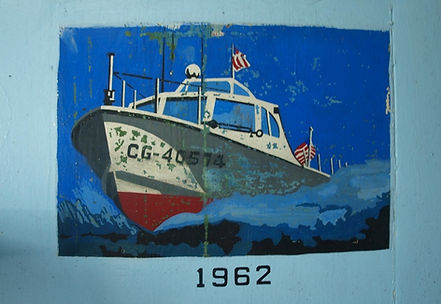
Photo from the Tim Sweet Collection
Historic
Rescues


_edited.jpg)
_edited.jpg)

January 22, 1931
On this day in history (1-22-1931) the Door County News reported: After being adrift for about four hours on an ice field which carried them more than a mile into Green Bay, three Gills Rock fishermen, Harry Voight, Harry Sittie and Walter Mickelson, were rescued last Thursday by the coast guard crew of the Plum Island station. The men had ventured out on the ice during the day in an attempt to recover a skiff, lost the previous day, and while searching for the skiff the ice broke loose from shore and they were well out into the bay before noticing their plight.
Too far from shore to signal for help, the three men were in grave danger of being carried out into the bay where the ice field would be dissolved unless a passing carferry or the coast guard crew could be notified to come to their assistance. The Ann Arbor carferry No. 7 it was understood, passed during the time the men were on the floe but apparently did not sight them, and it was not until friends at Gills Rock noting their disappearance, called the coast guard crew and asked for aid.
January 27, 1906
On this day in history (1-27-1906) the mail carriers have had trouble lately due to ice cakes floating through the Door with shifting winds and currents. A week ago, Saturday they were forced to cross the dangerous passage in a small skiff and while everything went well on the outward trip, matters were less favorable on the return passage, owing to the addition of two passengers. The craft was so small that the four men had hardly room to move and their combined weight loaded the boat to the gunwales with imminent danger of swamping in the brisk sea that was running. To make a bad matter worse one of the row-locks broke, necessitating running before the wind and sea. Fortunately, Lightkeeper Chas. Young on Plum Island kept an eye on the frail craft and phoned Capt. Egle at the life station on the east side. A boat was quickly manned and the two gentlemen together with George Cornell hurried to the rescue. Having reached the skiff the four men were taken aboard the large boat and landed safely at Detroit Harbor. Doubtfully the quartet would not have reached land without the rescue party. A lesson to carriers not to attempt too much or take too great chances in crossing the treacherous channel in the dead of winter in a frail skiff. From Washington Island: A Maritime History through the Years, Vol II.
January 30, 1925
On Friday last week a strong SW wind broke the ice through the Door and far into Green Bay. On Carl Christenson's return trip with the mail. This took him into such rough ice that the sleigh capsized and the horse fell. The Coast Guard Capt. Geo. Moe said it was one of the roughest trips he ever made. Monday, Carl's horse fell through the ice, but timely arrival of the Coast Guard saved the animal. There has been a little thought and less criticism but it is much easier to sit by a warm stove and criticize than to get out and carry the mail. From Washington Island: A Maritime History through the Years, Vol II.
February 3, 1922
Drifting around on a cake of ice in Death's Door is becoming a common occurrence for Pete Anderson mail carrier between Washington Island and the mainland. On Tuesday he had another experience similar to the one of two weeks ago when he and his companions were rescued by the Plum Island Coast Guard.
The experience Tuesday occurred practically in the same place, the ice starting to break up when Anderson was on his way from the Island to the mainland. Before he could get back to the Island the ice had broken loose from the shore, cutting him off. The lighthouse keeper at Plum Island notified the Coast Guard crew and with a small light skiff they crossed the ice to the open spot. Taking a line they fastened it to the large ice cake on which the mail carrier and his horse were marooned and pulled them across 200 feet of open water onto solid ice. From Washington Island: A Maritime History through the Years, Vol II.
March 8, 1949
On this day in history (3-8-1949) the Door County Advocate reported: Four fishermen from northern Door County were rescued from ice floes Monday night after drifting for eight hours off Washington Island.
The rescued men were two Weborg brothers, Lawrence, 30 and Gordon, 23 and Frank Teske Sr. 57, and his son Frank Jr., 24.
The men were landed at 8:40 p.m. by a coast guard lifeboat from Plum Island, which had been sent to their rescue after planes had discovered the men floating on the broken ice.
Three men are stationed on Plum Island during the winter for just such an emergency, and they launched the motor lifeboat to attempt the rescue.
March 10, 1935
Plunging through the thin ice in 120 feet of water of Death's Door 2 miles from Gills Rock about noon, Sunday six local men who were driving back from a basketball game held the night before in Ellison Bay, lost their lives by drowning, causing the greatest tragedy this island has ever experienced. All of the bodies and the car, a Ford coach, have been recovered as a result of excellent work by coast guards and many volunteers.
From the Door County Advocate
March 22, 1940
On this day in history (3-22-1940) the Door County Advocate reported: On Monday the coast guards were called to the aid of the mail boat WELCOME which had broken its shaft and lost its wheel in drift ice a short distance from the North Port dock. They towed it to the station at Plum Island where it was pulled out. The boat had docked with the mail and passengers and was returning to the island when the accident occurred.
May 18, 1902
The steamer, ALEX McDOUGALL, was stranded on the south point of Plum Island at 4 pm during thick fog. Life-saving crew sounded around her, and after she had released herself piloted her into deep water. From the United States Life-Saving Service 1902.
May 22, 1902
The steamer, JAMES R. COLEGATE, stranded on Pilot Island at 7 a.m. during foggy weather, with barge No. 137 in tow, Life-saving crew pulled to her in the surfboat, a distance of 2-1/2 miles. In compliance with a request of her master, they rowed him 10 miles to Ellison Bay to enable him to telephone for wrecking tugs. Upon their return they found that the mate had worked her afloat during their absence. She picked up her tow and proceeded to Escanaba under her own steam. From the United States Life-Saving Service 1902.
May 25, 1896
The steamer, THOMAS CRANAGE, stranded during heavy fog, about one mile from the Plum Island station. Upon hearing the signal of distress, the keeper and two surfmen who were there and a volunteer launched a skiff and enlisting the aid of the Pilot Island Lighthouse keeper, who was at the station in his sloop, were towed to the scene of the stranding. In the meantime, the mate of the CRANAGE had been picked up by a passing steamer and taken to Escanaba where he obtained a towboat. When he returned with the tug the life-savers rendered assistance by carrying messages and running lines until the vessel was finally floated free. From "Ships and Shipwrecks in Door County, Wisconsin - Volume Two by Arthur C. and Lucy F. Frederickson.
June 4, 1899
The schooner O.M. NELSON stranded on the south end of Pilot Island during a southerly gale with fog. The lifesaving crew from Plum Island rescued the crew, and a wrecking tug arrived later to try to release the NELSON but failed. From the "Schooner Days in Door County," by Walter M. and Mary K. Hirthe.
June 9, 1900
On this day in history (6-9-1900) the Door County Advocate reported: The steamer HAVANA, of Port Huron, stranded on the south point of Plum Island at 2:45 p.m., May 30, during the prevalence of a dense fog. The life-savers under the command of Captain Inger Olson, immediately went to her assistance and they stayed by until 4:40 the next morning, when the stranded ship succeeded in releasing herself.
June 23, 1911
The life-saving crew at Plum Island have had several calls so far this season, the most important of which was on the steamer CHAS. A EDDY, which grounded on Gravelly Island in Poverty passage. They put in a week assisting in his release. From Washington Island: A Maritime History through the Years, Vol II.
July 22, 1938
At 12:00 p.m., the 50-ft yacht, RANGER, went aground on the southwest shoal off Pilot Island. The Plum Island Coast Guard was called and at 2:00 a.m. they succeeded in getting the yacht off and towed her in to Plum Island. From http://www.panama-yachting-services.com/ranger---sea-phoenix.html and The Door County News 07-28-1938.
July 25, 1905
On This day in history (7-25-1905) The GEORGE PRESLEY burnt to the waterline after a fire broke out in the paint locker. The Presley was a 295' ore steamer enroute to Escanaba from Milwaukee. By the time the fire was found it was too late to extinguish it. The crew was able to escape in boats and were rescued by the Plum Island Lifesaving Station. She was scuttled ashore of West Harbor, Washington Island. Later she was towed to Sturgeon Bay (?) to recover her boilers and ore. Centerboard on display at Gibson's West Harbor Resort, Washington Island.
August 8, 1896
Captain Henrich of the steamer WAVERLY was more than pleased with the good work performed by the Plum Island life-saving crew. Captain Ingar Olson and crew of the Plum Island life-saving station, rendered all possible assistance to Captain Henrich of the WAVERLY, in carrying dispatches and help in lifting her off. The crew was on duty for seventy-two hours. The grounding of the steamer WAVERLY in the Door passage last week makes a total of five disasters the Plum Island life-saving crew have responded to and rendered assistance since the opening of the station. This is a splendid showing to say the least and demonstrates the importance of establishment of that kind. From Washington Island: A Maritime History through the Years, Vol II.
October 9, 1913
On this day in history (10-9-1913) the steamer CEPHUS ran aground off St. Martin's Island. As there was no life boat station at the island, the lighthouse keeper sent for the lifesaving crew from Plum Island. They made the 22-mile run in a powered lifeboat. They ran hawsers between their boat and the Tender Hyacinth, which was making her supply rounds, and the Cephus was soon afloat.
About the time the CEPHUS came off the shoal and while the life-saving crew was assisting with the lines, a squall broke, with rain and hail so thick the men could not see the length of the lifeboat. In an attempt to keep out of the trough of the rough seas, the lifeboat, going at full speed, crashed into the CEPHUS amidships. The lifeboat split her stem, fortunately above the waterline. Her crew was taken aboard the Hyacinth and returned to the Plum Island station in the morning. The stranding of the CEPHUS damaged her to the amount of $8,000. From Ships and Shipwrecks in Door County WI, Volume I by Arthur C. and Lucy F. Frederickson.
October 25, 1887
On this day in history (10-25-1887) The Advocate reported: The schooner PEWAUKEE was bound for Garden Bay on the Garden Peninsula of Upper Michigan. At 6:00 A.M. she went on Detroit Island Reef near Detroit Island in the dreaded Death's Door and was soon carried up on the shoal by the heavy sea that was rolling in at the time. The PEWAUKEE's crew, with the help of the lifesaving men from the Plum Island Station, stripped the schooner, which was said to be fast going to pieces. The tug Spaulding returned to Surgeon Bay on the thirty-first, having failed to release the vessel, which her owners had abandoned.
October 26, 1910
On this day in history (10-26-1910) the life-saving crew had a thrilling experience when going to the wreck [J.W. WESTCOTT]. A gale from the NE was blowing and a heavy sea running. Twice the life-boat was literally swamped by the tremendous seas which broke over and filled the craft with water, and on one occasion one of the life-savers was nearly washed overboard by a great wave. Being kept right side up she bailed herself out and Captain Whelan kept the craft on her course. From the Advocate.
October 30, 1899
On this day in history (10-30-1899), schooner E. M. STANTON had a close call from dragging ashore at Plum Island. The life-saving crew went to her assistance as soon as her dangerous position became apparent, and heaving in one anchor, and clapping sail on the vessel they slipped the other anchor and sailed her into a good and safe anchorage. The feat was accomplished in less than an hour's time, and the gallantry and skillful seamanship displayed by the life-savers brought forth showers of praises from the captain and crew of the STANTON. The captain says it was the narrowest escape he has had in twenty years of a sailor's life. From the Advocate
November 8, 1913
On this day in history (11-8-1913) the Plum Island life-savers under Capt. William Robinson made valiant efforts to succor the imperiled seamen on the HALSTEAD. A line was shot over the vessel during the height of the gale, but before the breeches buoy could be rigged up the boat was picked up on the top of a tremendous wave and carried bodily up on the beach. It was a thrilling time for the crew of the Halstead, who momentarily expected their craft to be thrown upon the rocks and smashed. The seas that run into harbor were the largest within the memory of the oldest inhabitant.
Two more schooners were still then out at anchor, the J.M. STEVENS and the MINERVA, which had come in before the storm, and so the life-savers remained on the scene for forty-eight hours watching their boats and prepared to save the crews if the hooks could not hold. Eye witnesses say it was the most thrilling sight they had ever seen; the two vessels at one moment being on the crest of an enormous billow and the next going out of sight in a smother of foam. How they weathered the storm is a mystery, it being little short of a miracle. From the Sturgeon Bay Advocate, 11-13-1913.
November 8, 1913
The steamer LOUISIANA was totally destroyed by fire at Washington Harbor, Wis. Her crew of seventeen men got ashore without much assistance, the boat being beached but a couple of rods from shore, the water being very bold at the point.
The Louisiana had delivered a cargo of coal at Milwaukee and was bound from there to Escanaba for ore. The storm which broke over this section about midnight struck the Louisiana in all its fury and she was not able to keep her course, so an effort was made to get into Washington Harbor for anchorage. this was done but the tremendous wind and sea was too much for her and she dragged closer to the beach by morning. Then it was discovered that there was a fire in the hold and after an ineffectual attempt to extinguish the flames the craft was abandoned.
Word had immediately been sent to the Plum Island life-savers who responded by hauling the beach apparatus overland to the scene. The crew having escaped, nothing could be done to save the vessel and the craft burned to the water's edge. From the Sturgeon Bay Advocate, 11-13-1913.
November 10, 1910
Bo Anderson and son nearly drowned in a snow squall at West Harbor Monday eve. They were out with a small vessel being towed by a gas-powered boat. The boat capsized and prompt appearance of Plum Island Life Savers prevented a tragedy. Washington Island: A Maritime History through the Years, Vol II.
November 12, 1914
Plum Island life-savers have been doing efficient work the past several days in rendering aid to the stranded schooner RESUMPTION. From Washington Island: A Maritime History through the Years, Vol II.
November 12, 1905
On this day in history (11-12-1905) the steamer, R.J. HACKETT, is completely destroyed by fire at Whaleback Shoal. Lifesavers from the Plum Island Life-Saving Station (11 miles away) noticed the smoke and rowed their boat against the strong winds to rescue the crew. It took them four hours to get there, and by that time, the ship was doomed and the 13 people on board had safely launched their two yawl boats. However, their trip was not in vain; Captain Egin and several of his life-saving crew boarded the bow and secured the captain's and mate's papers from the pilot house, items which had been forgotten in the hasty departure. The wreck site was listed on the National Register of Historic Places in 1992. From "Shipwrecks at Death's Door," by Cris Kohl and Joan Forsberg.
November 16, 1950
The LEBANON, owned by the Bethlehem Transportation Co., was empty and out-bound from Escanaba when it strayed from its course and went aground on a shoal at 4:30 a.m. A fog covered the area at the time.
A coast guard lifeboat from the Plum Island station was sent to the scene to remove the 33-man crew if necessary but the Lebanon was not in danger of sinking. Meanwhile the coast guard cutters Mackinaw, Hollyhock, the tug John Roen IV of Sturgeon Bay and the tug Favorite of Sault Ste. Marie were started to the scene.
The rescue ships turned back, however, when the Lebanon worked free with the help of a wind shift eight hours after the grounding. The ship returned to Escanaba for inspection of damage. From the Door County Advocate, 11-30-1950
December 4, 1927
On this day in history (12-4-1927) the crew on the OIL QUEEN, a 52-foot boat narrowly escaped death Thursday evening when they were caught in a gale while attempting to cross Death's Door. The boat grounded on Plum Island reef after being tossed about for many hours. The Plum Island coast guards witnessed the grounding of the boat and, due to their prompt action, no doubt saved the lives of the two men. The island crew was in command of Boatswain Fred Sollman and for two hours they battled their way before they were successful in approaching the boat and rescuing the two men. From the Door County News, 12-8-1927
December 6, 1940
On this day in history (12-6-1940) the Door County Advocate reported: Stranded fast on a rocky reef a mile from Sand Bay for 26 hours while waves threatened to pound to pieces their 40-foot fish tug KING, three local men, Victor and Richard Johnson, brothers, and Harry Carolson narrowly escaped death Tuesday night but were finally taken off in safety at 2:30 Wednesday afternoon by Plum Island and Canal Coast Guards who stood by throughout their plight until conditions improved enough to effect the rescue.
Dense steam over the lake from extreme cold caused the KING to get off her course as she headed for the Sandy Bay dock late Tuesday afternoon. Lawrence Weborg of Gills Rock called the Plum Island Coast Guard station when lights of the boat were seen offshore, and Magnus Olson set out in charge of a crew consisting of Paul Cornell, Earl Malloch and Philip Peterson. Unable to get near the tug with the life boat, they went back for the surf boat, and four men from the Canal Station, George Olson, Donald Langhor, Joe Etienne and Jose Schultz, joined in the work, bringing with them the Baileys Harbor Coast Guard skiff which was pulled to the rescue after a line was shot to the men.
Several lines parted as the crew tried to release the tug, and yesterday the lighthouse tender Hollyhock was called. It had not yet been determined if the craft could be saved.
December 18, 1924
Plum Island U.S.C.G. rendered assistance to the gas freighter GOLDEN GIRL when she sprang a leak while trying to break through heavy ice clearing Detroit Harbor on Thursday. The Coast Guard had to shift cargo before repairs. The leak was stopped and she was towed to safe anchorage by the C.G. craft. From Washington Island: A Maritime History through the Years, Vol II.
December 22, 1922
In heavy seas off Detroit Island last Friday night, the small freighter DIANA, which was being towed to the Island by the NAVARRE, broke loose from its tow and was grounded. With temperature below zero, both boats were covered with ice half way up their spars and were in danger of sinking on account of the enormous ice weight.
A heavy fog, lying low over the water, made it impossible for the NAVARRE's crew to locate the little freighter after she'd broken loose from her line and drifted out of sight. After a half hour's search Capt. Peter, of the tow boat, called the Plum Island Coast Guard. In the search that followed the NAVARRE found the DIANA almost before they realized its proximity. The crew of the ice-logged boat lost no time jumping aboard the rescue boat leaving their boat to its fate.
Covered with ice from bow to stern, from water line almost to the spar tip, the little freighter was ice-logged. The sea caused the cargo to shift to one side and almost capsized the boat. Capt. Anderson and Engr. Anderson, manning the ship, came near losing their lives on the slippery decks before assistance could reach them. From Washington Island: A Maritime History through the Years, Vol II.
December 23, 1926
On this day in history (12-23-1926) The Door County News reported: Crossing Death’s Door passage the latter part of last week was made with a great deal of difficulty by the mail boat, but Capt. Carl Christenson was equal to the emergency being determined that Santa Claus was not going to miss the children on the island if he could help it.
The cold snap froze the passage from shore to shore, but it was not firm enough to bear the weight of a horse and cutter, so it was up to Captain Christenson to make the trip in his mail boat. He found it a difficult job on Thursday but succeeded in making the crossing.
The Plum Island coastguard crew assisted him, or it is doubtful whether he would have been able to break his way through the embargo. There was a strong wind blowing from the west and the temperature below zero when he started out with several passengers and the mail. At one place on the trip it required twelve hours-time to cover a distance of three miles, which will give some idea of the difficulty experienced.
December 29, 1910
On this day in history (12-29-1910) The Ann Arbor car ferry No. 4 went ashore on outer shoal near Plum Island, in Death's Door, at six o'clock in the morning while bound to Menominee from Frankfort, Mich. A telephone message was sent from Plum Island to the Leathern & Smith Towing & Wrecking Co. of this city for a tug and the big tug John Hunsader was sent to the relief of the stranded craft. Ann Arbor No. 3 went to the relief of its sister ship in the afternoon, but after a short stop continued on her way to Menominee and will assist the Hunsader in releasing No. 4 on her return trip.
The captain of the Plum Island life station, and also the captain of the Baileys Harbor station, together with a number of the men who belonged to the lifesaving crews during the past season, are at the wreck, rendering what assistance is necessary. From the Door County Democrat, 12-30-1910.
December 31, 1898
On this day in history (12-31-1898) the Advocate reported that the screw steamer LEWIS PAHLOW, 356 tons 155.4 ft length, with consort barges Delta and D.L. Filer, 269 tons 131 ft length and 357, 156.6 ft length, ran on a reef between Plum and Detroit Islands. The outfit was lumber-laden from Thompson to Chicago. After leaving Thompson the Delta lost part of her deckload and became waterlogged, it becoming necessary to drop the Filer and take the Delta alongside. The Delta was anchored under Plum Island, and the Pahlow, in going back to look for the Filer, ran upon the reef as stated above. She was lightened of part of her cargo before she could be floated. The lumber was reloaded. The Plum Island life savers assisted in the work.